Financial institutions · Industry · Services
AI that thinks and works like your expert.
We don't stop at a prompt on someone else's model. We train the model on your data, for your work; it runs in your systems, and it's yours.
Inside your limits, the work gets done. Above them, your expert says yes or no.
How it works
One system, four steps.
- ScoreML models put a number on the case, with its drivers.Machine-learning models
- ReasonA language model trained for your institution reads the score and the documents like your expert, reasons, and picks the right next step.Small language models, trained for your domain
- ActAgents gather the evidence, prepare the case, and complete what falls inside your written limits, in your systems.Agentic AI systems
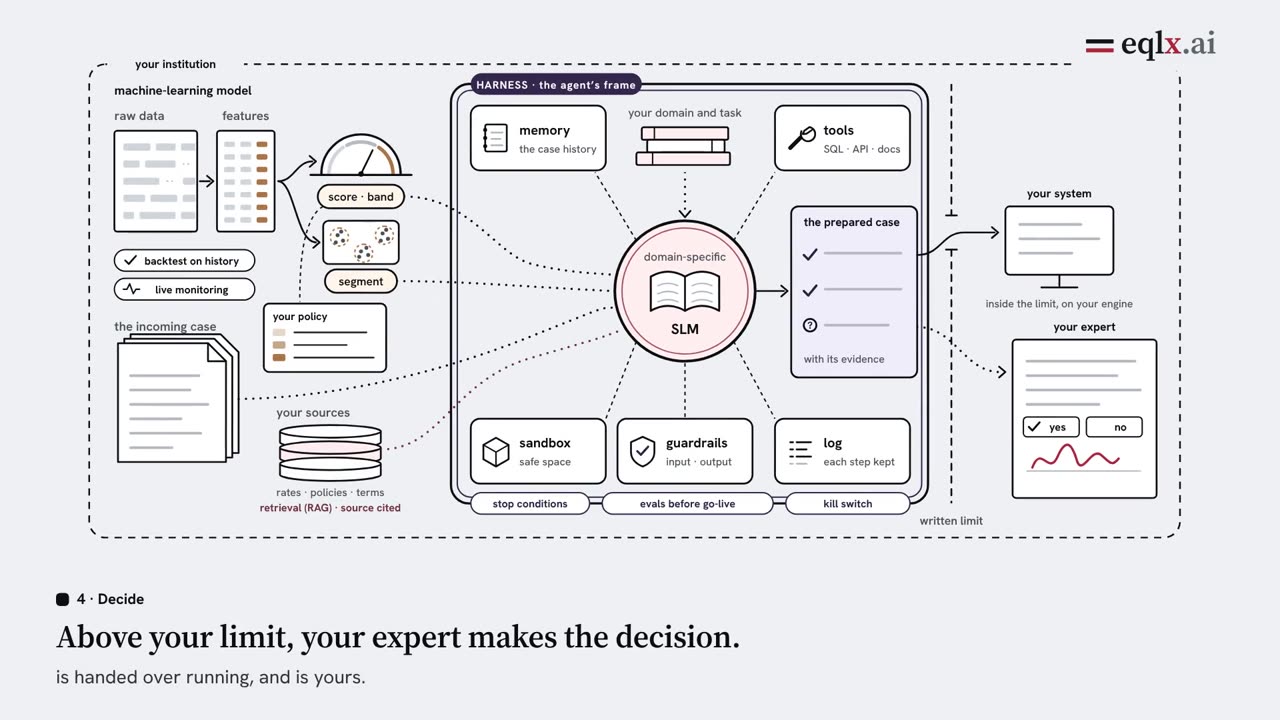
- DecideAbove the limit the decision arrives prepared; your expert says yes or no.Your expert
Every step is recorded.Every decision can be explained.
Each part works on its own; together where the work needs it.
AI that thinks and works like your expert. We don't stop at a prompt on someone else's model. We train the model on your data, for your work.
Machine-learning models. Learns from how your past cases turned out: a score, a probability, a forecast. Tested on your history, monitored live. Your policy writes the action for each band.
Small language models, trained for your domain. First, it's trained for your institution, domain, and work. It must pass your expert's test. Now it is your institution's own model. It reads and reasons like your expert, and calls the right tool. Changing facts come from your sources, cited.
Agentic AI systems. Built around the model: memory, tools, limits. It prepares each case end to end. Inside your written limit, it's completed in your systems. Above it, your expert approves: yes or no. Every step is logged; one switch stops it.
Above your limit, your expert makes the decision. It all runs in your systems, is handed over running, and is yours. Each part works on its own; together where the work needs it.
Every step is recorded. Every decision can be explained. Start with a Decision Blueprint.
Solutions
The work in your business that takes expertise. Open an area to see every system we build there.
Financial institutions & fintech34 use cases
Credit underwriting
Scores retail, small-business (SME), and corporate applications, checks the invoices, paper checks, and appraisal reports behind them, and prepares each for the decision.
What we build here · open one to see how it works
Credit monitoring and limit management
Sees the customer slipping before the arrears show it.
What we build here · open one to see how it works
Collections and non-performing loans
Tells who needs a call from who needs a payment plan, and prepares the bid on a non-performing portfolio.
What we build here · open one to see how it works
KYC and sanctions screening
Traces a company's registry papers to its beneficial owners and signatories for know-your-customer (KYC) checks, and prepares every screening hit for the analyst.
What we build here · open one to see how it works
Fraud, financial crime, and regulatory compliance
Prepares fraud and laundering alerts, regulatory changes, and participation-banking reviews for the expert.
What we build here · open one to see how it works
Payments and card operations
Traces a stopped or returned payment, prepares each card dispute, and drafts the answer to the other bank.
What we build here · open one to see how it works
Garnishments, estates, and official letters
Reads the order or the inheritance papers, finds every account, and drafts the answer on time.
What we build here · open one to see how it works
Trade finance and letters of credit
Reads the documents under a letter of credit and checks them against the credit and each other.
What we build here · open one to see how it works
Pricing and cross-sell
Proposes the loan rate, the deposit rate, and the offer from how each customer responds to them.
What we build here · open one to see how it works
Insurance underwriting and claims
Prepares each proposal and each health provision request, moves the simple claim to the fast track, and finds what can be recovered.
What we build here · open one to see how it works
Investment services and fund compliance
Checks each client's answers against the product and each fund against its limits, and reads every disclosure on your holdings.
What we build here · open one to see how it works
Request and complaint routing
Routes every customer message to the desk that owns it, before its legal deadline runs out.
What we build here · open one to see how it works
Industry4 use cases
Predictive maintenance
Sees the machine stop coming and drafts the work order.
What we build here · open one to see how it works
Quality control and 8D
Finds the defect in the image and drafts the nonconformance report and the 8D (eight disciplines) report with its evidence.
What we build here · open one to see how it works
Yield and scrap analysis
Finds the setting most likely behind the scrap.
What we build here · open one to see how it works
Services10 use cases
Contact center quality and agent assist
Checks every call for quality and compliance, and helps the agent during the call.
What we build here · open one to see how it works
Complaints and customer claims
Drafts the answer to a complaint, an arbitration case, or a passenger claim.
What we build here · open one to see how it works
Customs and tax filings
Checks each declaration against its invoice and papers, and prepares the value-added tax (VAT) refund file for the advisor who signs it.
What we build here · open one to see how it works
Hospital billing and SGK audit
Checks every billed line against the medical record and the rules before the invoice goes to the Social Security Institution (SGK).
What we build here · open one to see how it works
Field inspection and returns
Reads the field team's and the warehouse's photos, and prepares each inspection or return for the person who signs it.
What we build here · open one to see how it works
These use cases describe systems we build, based on how these desks really work. No customer's data appears on this site: we wrote every name and amount in these documents ourselves. We show it on your data, in your environment, in the Decision Blueprint.
Not rented: trained for you
Your expert writes the test. The model goes live only on the work it passes.
Test first
Your expert grades real past work, before any training.
Train on your work
The model learns from work your team already decided.
Same test again
The same work, the same grader.
Live where it passed
The rest stays with your experts.
What we build
Three kinds of AI; each works on its own.
- Machine-learning modelsLearns from how your past cases turned out: scores, probabilities, forecasts, and the action your policy writes for each band.Read more
- Small language models, trained for your domainKnows your field's language: reads like your expert, calls the right tool, and writes in your format. The model stays yours.Read more
- Agentic AI systemsGathers the evidence and prepares each case; inside your written limits it completes the work, above them it hands it to your expert.Read more
All of it connects to the systems you already run: core banking, ERP and MES, CRM and the contact center, your decision engine. What it connects to
How we start
Each engagement starts with one piece of work and ends with the system handed over running.
Decision Blueprint
Typically 2–4 weeks
It ends in a written plan.
- Build · Adjust · Pause · StopYou decide
Validation build
Typically 4–8 weeks
Measured on your past work, with your expert's test.
- Go live?You decide
Production, integration, handover
Typically 3–6 months
Goes live only on the work it passed.
- The model, its weights, and your data stay with you; base-model licenses still apply.
- We sign a non-disclosure agreement (NDA) before any detail, and keep no standing remote access.
- Everything is documented, so the system never depends on one person.
We come into your environment, build beside your team, and hand the system over running.
About eqlx- · 5 min readSmall language model or a large general model (LLM) for one task?On one narrow task a trained small model often matches a large general model. A graded test set decides, not the size.Read the note
- · 5 min readAgentic AI or RPA: when each one fitsRobotic process automation (RPA) repeats fixed steps on structured data; an agentic AI system reads documents and chooses its next step. When each one fits, and how they work together.Read the note
- · 4 min readBuild or buy an agent platform?What an agent platform contains, which parts an institution should own, which it can adopt or buy, and six questions to ask before choosing, from where it runs to how you leave.Read the note
Open research: 6 finance tools, 1,258 tests, every number checked against an independent source. How the tools are tested · Models on Hugging Face
Equalize the gap.
Bring work that takes expertise. Leave knowing the first step.
A short description of the work is enough; no confidential records.
- You send a short descriptionNo confidential records, credentials, or production data
- An engineer checks whether it fits, and what it would needA model, a small language model, an agent, or none
- A proposed first step, or an honest “not a fit”Agreed in a technical conversation with an engineer
https://eqlx.ai · Printed copy; the website is the current version.